
SoftWave Therapy Media, PA
If you’re looking for SoftWave Therapy in Media, PA, Everybody’s Chiropractic Center provides advanced, non-invasive SoftWave treatment at our nearby Upper Darby office. Patients from Media visit us for conservative care involving plantar fasciitis, knee pain, shoulder pain, tendon injuries, tennis elbow, golfer’s elbow, arthritis, chronic joint pain, and other appropriate musculoskeletal conditions.
SoftWave Therapy uses acoustic-wave technology designed to stimulate biological responses in targeted tissue. Before recommending treatment, we evaluate your symptoms, health history, functional limitations, and examination findings to determine whether SoftWave Therapy may be appropriate for your condition.
Everybody’s Chiropractic Center has served Delaware County since 1995, and Dr. Dan Klein has more than 30 years of clinical experience.
Patients primarily searching for spinal adjustments, back pain treatment, neck pain care, sciatica treatment, or general chiropractic care should visit our separate Media Chiropractor page.
What Is SoftWave Therapy?
SoftWave Therapy is a non-invasive treatment that uses acoustic waves delivered through a handheld applicator to a targeted area of the body.
The technology is designed to stimulate biological responses within muscles, tendons, ligaments, joints, and other musculoskeletal tissues.
SoftWave treatment itself does not require surgery, incisions, injections, or anesthesia. In addition, patients generally require little to no downtime following treatment.
However, not every painful condition is appropriate for SoftWave Therapy. Therefore, an evaluation is important before treatment recommendations are made.
Why Media Patients Choose SoftWave Therapy
Some patients begin researching SoftWave Therapy because a persistent musculoskeletal problem continues to interfere with walking, exercise, work, sports, sleep, or everyday activities.
Depending on the diagnosis and examination findings, we may consider SoftWave Therapy for:
- Plantar fasciitis and heel pain
- Knee pain
- Shoulder pain
- Tennis elbow
- Golfer’s elbow
- Tendon-related conditions
- Achilles tendon problems
- Certain sports and overuse injuries
- Arthritis and chronic joint discomfort
- Other appropriate soft-tissue and musculoskeletal conditions
Additionally, some patients want to explore conservative options before considering more invasive treatment.
Whether SoftWave Therapy is appropriate depends on the individual patient rather than the symptom alone.
Conditions We Evaluate for SoftWave Therapy Near Media
Plantar Fasciitis and Heel Pain
Plantar fasciitis can cause persistent heel and foot pain that makes standing, walking, exercising, and working difficult.
For appropriate patients with chronic plantar fascia symptoms, SoftWave Therapy may be considered as part of a conservative treatment plan.
Learn more about SoftWave Therapy for Plantar Fasciitis.
Knee Pain
Knee pain may involve tendons, muscles, joints, or surrounding tissues. Arthritis, repetitive activity, sports, and overuse may also contribute to symptoms in some patients.
Because knee pain can have several possible causes, we first evaluate the condition before determining whether SoftWave Therapy may be appropriate.
For more information, visit our Knee Pain Treatment page.
Shoulder Pain
Shoulder pain may develop from repetitive activity, sports, work, tendon problems, overuse, or other musculoskeletal conditions.
For certain conditions involving the shoulder and surrounding soft tissues, SoftWave Therapy may be considered as part of a conservative treatment plan.
Patients can learn more about SoftWave Therapy for Shoulder Pain.
Tennis Elbow and Golfer’s Elbow
Tendon irritation around the elbow can make gripping, lifting, exercising, sports, and repetitive work uncomfortable.
After evaluating the source of the symptoms, we may consider SoftWave Therapy for certain tendon-related elbow conditions.
Learn more about Tennis Elbow and Golfer’s Elbow Treatment.
Tendon and Overuse Injuries
Tendon problems may develop from sports, exercise, occupational demands, repetitive activity, or long-term overuse.
Because acoustic-wave treatment is often investigated for tendon-related conditions, patients with persistent symptoms may benefit from an evaluation to determine whether they are appropriate candidates.
Arthritis and Chronic Joint Pain
Arthritis and other chronic joint conditions may cause pain, stiffness, and difficulty with normal movement.
SoftWave Therapy does not reverse arthritis or restore damaged cartilage. However, for certain patients, it may be considered as part of a conservative treatment plan focused on symptoms and function.
How Does SoftWave Therapy Work?
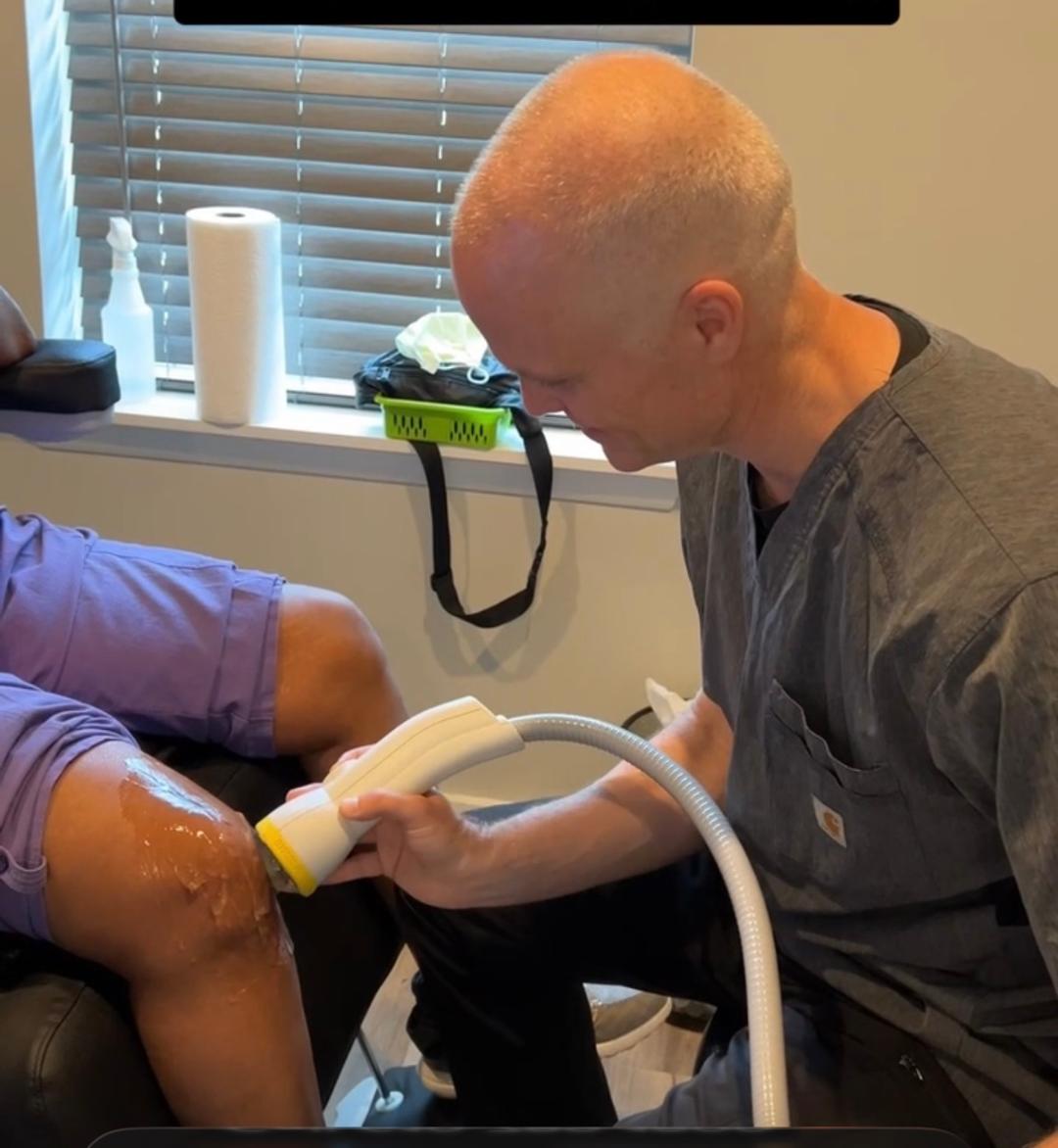
During treatment, a clinician applies the SoftWave applicator to the targeted area. Next, the device delivers acoustic waves into the treatment region.
SoftWave technology is designed to stimulate biological responses associated with circulation and tissue-repair processes.
Researchers continue to study extracorporeal shock wave and acoustic-wave technologies for many musculoskeletal conditions.
However, individual results vary, and research involving one condition or shock-wave system should not automatically be applied to every patient.
SoftWave Therapy, Shock Wave Therapy, and Acoustic-Wave Therapy
Patients researching treatment near Media may encounter several terms, including:
- SoftWave Therapy
- Shock wave therapy
- Extracorporeal shock wave therapy
- ESWT
- Acoustic-wave therapy
- Radial shock wave
- Focused shock wave
These terms are related, but they should not automatically be treated as identical.
Different systems create and deliver acoustic energy in different ways. At Everybody’s Chiropractic Center, we specifically provide SoftWave Therapy.
This distinction helps patients understand the technology we actually use rather than assuming all shock-wave systems are the same.
What Happens During a SoftWave Evaluation?
Before beginning SoftWave Therapy, we evaluate your condition to better understand what may be causing your symptoms and whether treatment is appropriate.
Depending on your condition, your evaluation may include:
- Review of your health history
- Discussion of when symptoms began
- Identification of activities that aggravate the problem
- Examination of the affected area
- Assessment of movement and function
- Orthopedic testing when appropriate
- Neurological testing when appropriate
- Review of previous imaging or diagnostic studies when relevant
- Discussion of previous treatments
Afterward, we explain our findings and answer your questions.
If we recommend SoftWave Therapy, we also discuss the treatment process and realistic expectations based on your condition.
What to Expect During SoftWave Treatment
SoftWave treatments take place at our Upper Darby office.
First, we apply gel to the treatment area. Next, the clinician moves the SoftWave applicator across the targeted tissue while the device delivers acoustic waves.
The exact treatment area depends on the condition being treated.
Afterward, many patients can return to normal daily activities. However, recommendations may vary depending on the individual patient and condition.
Is SoftWave Therapy Painful?
Most patients tolerate SoftWave Therapy well.
However, sensitive or symptomatic areas may feel temporarily uncomfortable as the applicator passes over them.
The sensation varies depending on the treatment location, condition, and individual patient. Therefore, we communicate with patients throughout treatment and make adjustments when appropriate.
How Many SoftWave Treatments Will I Need?
There is no single treatment schedule appropriate for every patient.
Recommendations may depend on:
- The diagnosis
- How long symptoms have been present
- Severity of the condition
- Location of the problem
- Previous treatment
- Functional limitations
- Overall health
- Response to SoftWave Therapy
Therefore, we develop recommendations after evaluating the individual patient rather than using the same schedule for everyone.
Research on SoftWave and Shock Wave Therapy
Researchers have studied extracorporeal shock wave therapy for a variety of musculoskeletal and orthopedic conditions.
For example, research has examined shock-wave treatment for plantar fasciitis, tendinopathies, chronic musculoskeletal pain, and other soft-tissue problems.
Evidence and expected outcomes vary depending on the diagnosis, treatment protocol, technology, and individual patient.
Patients interested in published research can review information from the National Institutes of Health and the Mayo Clinic.
In addition, the Cleveland Clinic provides patient information about acoustic-wave therapy.
SoftWave Therapy Near Media, PA
Everybody’s Chiropractic Center is located at 115 E Township Line Road in Upper Darby, PA 19082, providing convenient access for patients traveling from Media and central Delaware County.
Patients come to our office from downtown Media, Rose Tree, and surrounding Media-area neighborhoods.
Our Upper Darby location is accessible from Media using major local routes including Baltimore Pike (Route 1), State Road, West Chester Pike (Route 3), and I-476 (the Blue Route).
As a result, patients from Media can access SoftWave Therapy without traveling outside the Delaware County area.
We also provide SoftWave Therapy for patients from Springfield, Newtown Square, Broomall, Havertown, Drexel Hill, Upper Darby, Lansdowne, Clifton Heights, Yeadon, and surrounding Delaware County communities.
Why Choose Everybody’s Chiropractic Center for SoftWave Therapy?
Everybody’s Chiropractic Center has served patients throughout Delaware County since 1995, and Dr. Dan Klein has more than 30 years of clinical experience.
Media patients choose our office for SoftWave Therapy because we provide:
- Advanced SoftWave technology
- Evaluation before treatment recommendations
- Individualized treatment recommendations
- Experience evaluating musculoskeletal conditions
- Conservative, non-invasive treatment options
- Convenient access from Media
- On-site parking
- Spanish-speaking team members
Most importantly, we do not recommend SoftWave Therapy simply because a patient has pain.
Instead, we evaluate the condition and determine whether SoftWave may be an appropriate treatment option for that individual patient.
SoftWave Therapy vs. Chiropractic Care
SoftWave Therapy and chiropractic care are different treatment approaches.
SoftWave Therapy uses acoustic-wave technology directed toward targeted musculoskeletal tissues.
In contrast, chiropractic care focuses primarily on musculoskeletal evaluation, joint movement, spinal function, mechanical dysfunction, and related conditions.
Some patients may be appropriate candidates for SoftWave Therapy. Others may primarily need chiropractic care. In certain situations, more than one conservative treatment approach may be appropriate.
If your primary concern is back pain, neck pain, sciatica, headaches, spinal adjustments, or disc-related symptoms, visit our separate Media Chiropractor page.
This page specifically focuses on SoftWave Therapy near Media, PA.
Frequently Asked Questions About SoftWave Therapy Media
Is your SoftWave Therapy office located in Media?
Our office is located at 115 E Township Line Road in Upper Darby, PA 19082. We regularly provide SoftWave Therapy for patients who live and work in Media and surrounding Delaware County communities.
Is SoftWave Therapy non-surgical?
Yes. SoftWave Therapy is non-invasive and does not require surgery or incisions.
Does SoftWave Therapy involve injections?
No. SoftWave treatment itself does not involve injections. Instead, the clinician uses an applicator to deliver acoustic waves to the treatment area.
Can SoftWave Therapy help plantar fasciitis?
SoftWave and related shock-wave technologies have been studied for plantar fasciitis. However, whether treatment is appropriate for an individual patient depends on the diagnosis, symptoms, examination findings, and other factors.
Learn more about SoftWave Therapy for Plantar Fasciitis.
Can SoftWave Therapy be used for knee or shoulder pain?
SoftWave Therapy may be considered for certain musculoskeletal conditions affecting the knee or shoulder.
However, because knee and shoulder pain have many possible causes, we perform an evaluation before recommending treatment.
Can SoftWave Therapy be used for tennis elbow or golfer’s elbow?
SoftWave Therapy may be considered for certain tendon-related elbow conditions. An evaluation helps determine the source of the symptoms and whether acoustic-wave treatment may be appropriate.
Can SoftWave Therapy be combined with chiropractic care?
Yes, when clinically appropriate. However, not every SoftWave patient requires chiropractic treatment.
Recommendations depend on the patient’s condition and examination findings.
Do I need a referral for SoftWave Therapy?
Most patients can contact our office directly to schedule an evaluation.
For questions about fees or payment options, contact Everybody’s Chiropractic Center at 610-789-1800.
Schedule a SoftWave Therapy Evaluation Near Media
If plantar fasciitis, knee pain, shoulder pain, tendon problems, elbow pain, arthritis, chronic joint pain, or another musculoskeletal condition is limiting your activities, schedule an evaluation to determine whether SoftWave Therapy may be appropriate.
Everybody’s Chiropractic Center has served Delaware County since 1995, and our Upper Darby location provides convenient access for patients from Media.
Everybody’s Chiropractic Center
115 E Township Line Road
Upper Darby, PA 19082
610-789-1800
Request a SoftWave Therapy evaluation at Everybody’s Chiropractic Center.
For directions from Media, find Everybody’s Chiropractic Center on Google Maps.
We proudly provide SoftWave Therapy for patients from Media, Springfield, Newtown Square, Broomall, Havertown, Drexel Hill, Upper Darby, Lansdowne, Clifton Heights, Yeadon, and surrounding Delaware County communities